Sindh steps up climate action, strengthens research ties with universities,Dost Muhammad Rahimoon
Secretary Faisal Ahmed Uqaili Calls for Stronger University-Government Research Links to Inform Policy-Making
By Qurban Ali Khushik
Karachi (23 October): Sindh is stepping up efforts to tackle climate change, protect its coastal ecosystem and mobilise international climate finance, Adviser to the Chief Minister on Environment Dost Muhammad Rahimoon said on Thursday, stressing the need for coordinated action across government departments and academic institutions.
“More than a dozen Sindh government departments are working on climate change, and the chief minister has constituted a dedicated task force to coordinate these efforts,” Mr Rahimoon said while chairing the first meeting of the Task Force on Climate Change with Secretary Environment Faisal Ahmed Uqaili at a local hotel.
He said the government was taking measures to address wastewater, industrial pollution and solid waste in Karachi, with the target of bringing the discharge of polluted water into the sea down to zero. He also called for regular monitoring of seawater quality, mangrove plantation, protection of coastal ecosystems and measures to prevent residential construction on agricultural land.
The meeting reviewed climate mitigation measures, greenhouse gas emissions data, carbon financing, institutional capacity and coordination among government departments. Participants identified energy, transport, agriculture, forestry, water management and coastal protection as priority areas, with discussions focusing on renewable energy, electric vehicles, energy efficiency, land restoration, sustainable irrigation and climate-resilient farming.
Secretary Environment Faisal Ahmed Uqaili said the department had validated 13 carbon credit projects and forwarded them to the Ministry of Climate Change and Environmental Coordination, while six additional projects were under review.
He emphasised the need to bridge the communication gap between the government and universities so that scientific research and findings could inform policymaking. He also called for project-based internships for final-year students to strengthen young professionals’ engagement in climate change and environmental protection.
The meeting reviewed the Sindh Climate Change Policy 2022, recommendations relating to Nationally Determined Contributions (NDC 3.0), institutional arrangements and mechanisms for monitoring climate projects. Participants also discussed challenges in securing climate finance, particularly gaps in reliable data, project preparation and institutional capacity.
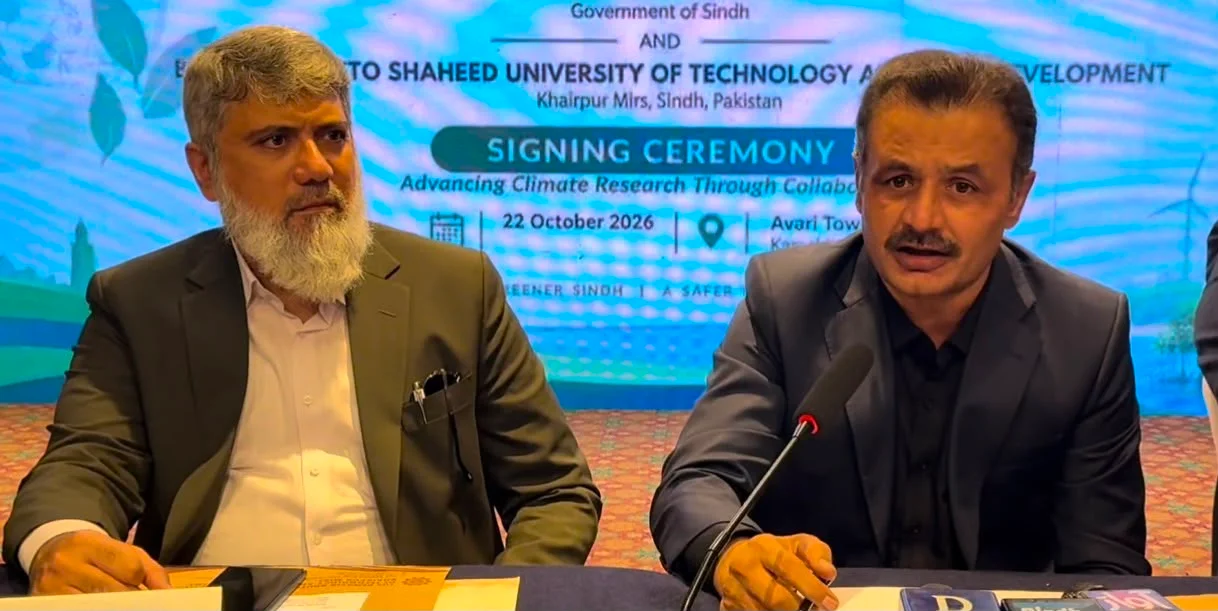
Two memorandums of understanding were signed between the Environment Department and Shaheed Benazir Bhutto University, Shaheed Benazirabad, and Shaheed Benazir Bhutto University of Technology and Skill Development, Khairpur Mirs, to promote cooperation in climate research, biodiversity, environmental protection, sustainable agriculture, indigenous plantation, education and information sharing.
Mr Rahimoon said the partnerships would raise environmental awareness among young people and help translate academic research into practical projects, while creating opportunities for joint research and training.
Earlier, a training session on the Water, Food and Energy (WEF) Nexus Country Platform Sindh was held with support from the Islamic Development Bank. Participants were briefed on integrated planning across the three sectors, climate project development and opportunities for securing financing.
The session, attended by the NDC Partnership team, highlighted how coordinated planning could reduce climate risks, improve natural resource management and support sustainable development in Sindh.
The meeting was attended by Executive Director Climate Change and Carbon Financing Syed Imdad Shah, Special Secretary Ayan Bhutto, representatives of the NDC initiative, environmental experts and senior government officials.