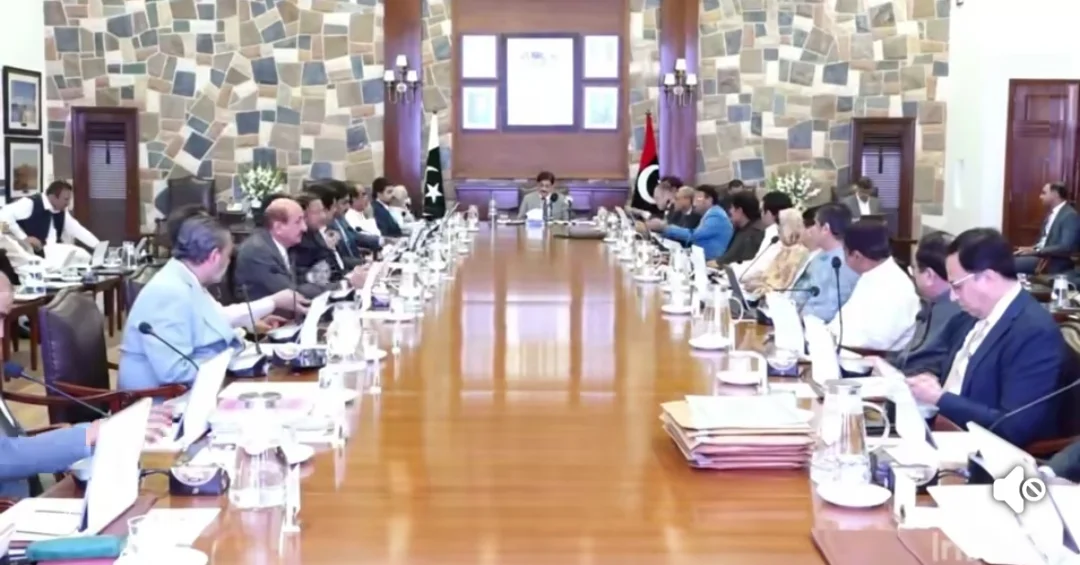
CM Murad Ali Shah briefs Sindh cabinet on China visit, highlights 34 agreements and investment opportunities
By Qurban Ali Khushik
KARACHI: Sindh Chief Minister Syed Murad Ali Shah on Tuesday briefed the provincial cabinet in detail on his recent visit to China, highlighting investment agreements, infrastructure development, digital transformation, water management, agriculture, healthcare and energy cooperation between Sindh and Chinese institutions and companies.
The chief minister said the key event of the visit was the Sindh Investment and Trade Conference in Shanghai, which aimed to attract Chinese investment to Sindh, create employment opportunities, promote industrial modernisation and translate agreements into implementable projects.
Around 400 delegates from government and business circles attended the conference, where a total of 34 agreements and memorandums of understanding (MoUs) were signed at government-to-government and business-to-business levels.
During the conference, Murad Ali Shah invited Chinese investors to explore opportunities in the Dhabeji Special Economic Zone, Education City Special Technology Zone and Sindh’s energy, minerals, agriculture and industrial sectors.
To ensure implementation of the agreements, the chief minister announced that a focal person would be appointed for each agreement. He also said progress would be reviewed at a high level and measures taken to ensure the security of Chinese nationals, projects and investments.
Digital transformation and artificial intelligence
On October 16, the chief minister visited Huawei’s Research and Development Centre in Shanghai, where an MoU was signed to establish Pakistan’s first AI-powered digital province.
The MoU was signed by Sindh Chief Minister’s Special Assistant on Investment Syed Qasim Naveed Qamar in the presence of Murad Ali Shah and Huawei Pakistan Chairman Ethan Sun.
The proposed cooperation covers the digitalisation of provincial e-governance, cloud infrastructure, a data centre, smart city solutions, artificial intelligence and information and communication technology (ICT) training for young people.
The chief minister identified a pilot project for urban management and flood early warning in Karachi as an initial priority. Other priorities include a roadmap for cloud infrastructure, data centres, cybersecurity and disaster recovery.
The establishment of an Innovation and Training Centre and an AI Smart Park at Karachi Education City was also discussed, alongside university partnerships to provide training and certification for young people. A joint working group and designated focal persons were proposed to advance the projects.
Murad Ali Shah invited Huawei’s team to visit Karachi to take the proposed initiatives forward.
Water management and flood prevention
Earlier, on October 12, the chief minister visited the Three Gorges Dam in Yichang, where Chinese officials briefed him on water storage, hydropower generation, flood control and river management.
He expressed interest in drawing on Chinese expertise to improve water storage in Sindh, strengthen flood early-warning systems, manage sedimentation and protect the Indus Delta.
Chinese officials expressed willingness to explore the exchange of technical expertise and institutional cooperation in water management and related fields.
On October 14, the chief minister visited Huawei’s City Operations Centre and the Wuhan AI Computing Centre. He received briefings on smart city systems, urban management, artificial intelligence and computing infrastructure.
He proposed launching a smart city platform pilot in Karachi to improve urban management and provide early warnings of floods. He also suggested AI training, access to computing resources and technical assistance for Sindh’s universities, researchers, engineers and government officials.
K-IV water project and Sukkur Barrage rehabilitation
During his October 13 visit to Wuhan, Murad Ali Shah met representatives of Chinese company HBSZ and invited them to begin construction of the 100-kilometre pipeline for Karachi’s K-IV water supply project as soon as possible. The company expressed willingness to cooperate and indicated its readiness to proceed.
The meeting also reviewed progress on the rehabilitation of Sukkur Barrage, being undertaken with the cooperation of China Road and Bridge Corporation and HBSZ.
Of the barrage’s 54 gates, 44 had been replaced, while the remaining 10 were being manufactured for shipment to Pakistan. Work was also under way on 110 canal gates. The project is scheduled for completion by June 30, 2027.
Agricultural cooperation and climate-resilient seeds
In Wuhan, the chief minister met Wang Shikai, chairman of agricultural company Qingfa Hesheng, and invited the company to help develop high-yielding, climate-resilient seeds for Sindh.
He called for cooperation in local seed production, technology transfer, joint research and farmer training. The chief minister was briefed that the company’s hybrid seeds had achieved reported increases of 20 to 30 per cent in rice yields.
He also met Pakistani scientist Dr Ahmed Ali, who works with the company.
The discussions reflected Sindh’s interest in using agricultural technology to improve productivity and help farmers adapt to changing climatic conditions.
Pharmaceutical investment
During his stay in Wuhan, the chief minister also met representatives of Humanwell Healthcare Group, also referred to as Renfu Pharmaceutical Group.
He invited the company to invest in pharmaceutical manufacturing facilities in Sindh, including the local production of active pharmaceutical ingredients (APIs) and finished medicines.
The company expressed willingness to send a technical delegation to Karachi to assess potential projects. Murad Ali Shah assured the delegation that Sindh’s Investment Department would facilitate the process and assist with regulatory approvals from the Drug Regulatory Authority of Pakistan (DRAP) and other relevant institutions.
Cooperation with Hubei province
The chief minister met Hubei Governor Li Dianxun and provincial Communist Party Secretary Guan Xiaotao to discuss cooperation in agriculture, information technology, education, vocational training, trade and the next phase of the China-Pakistan Economic Corridor (CPEC).
He invited Hubei-based companies to explore investment opportunities in Sindh’s green development, modern agriculture, industrial sector and business partnerships.
Potential areas of cooperation included hybrid rice and high-yielding seeds, agricultural machinery, cold-chain infrastructure, logistics, university partnerships, start-ups, smart port logistics, automation and traffic management.