
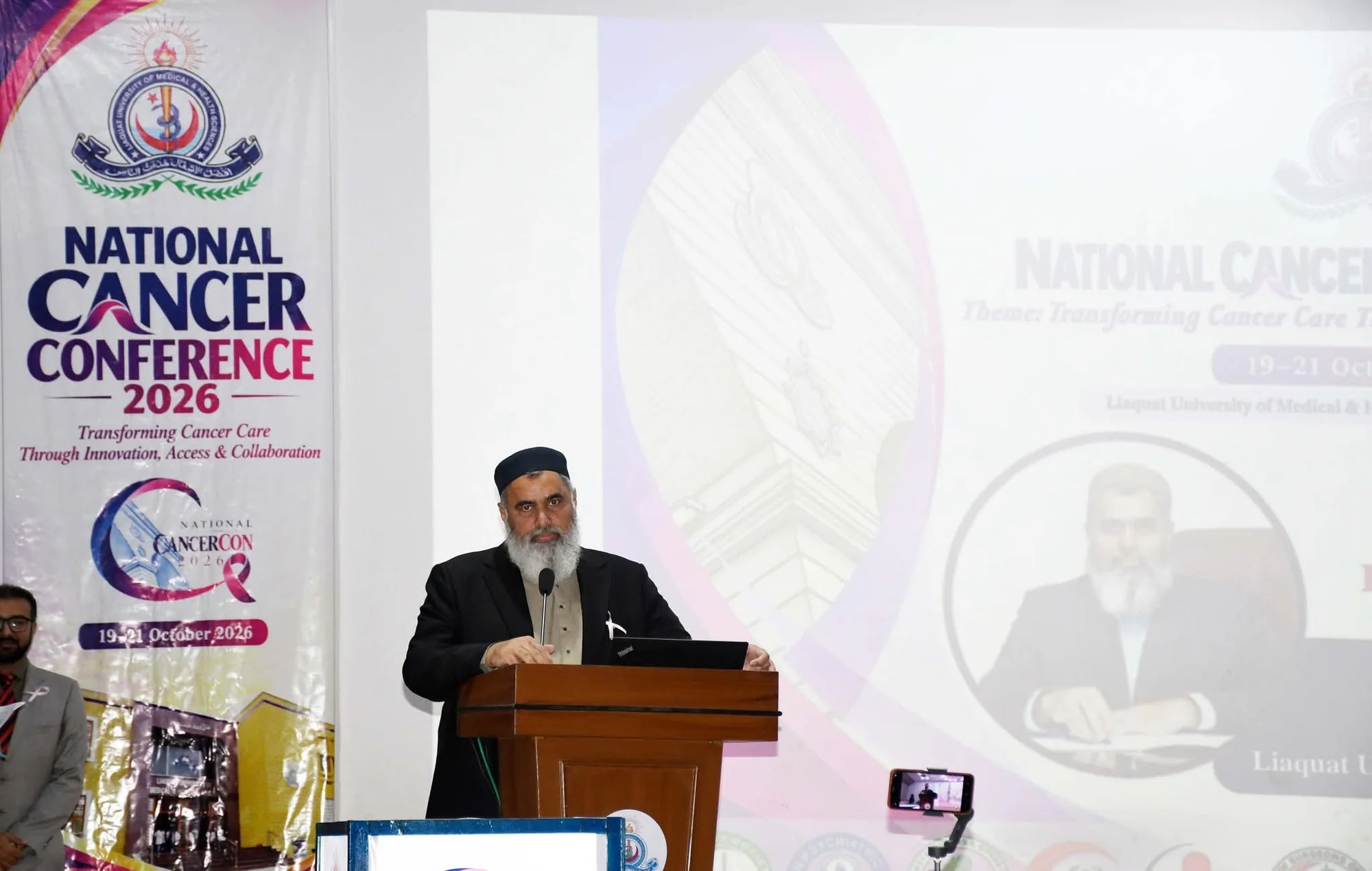
National Cancer Conference 2026 Begins at LUMHS with Focus on Innovation and Access
Experts Call for Early Cancer Diagnosis, Teamwork and Improved Patient Care at Jamshoro Conference
LUMHS Hosts Three-Day National Cancer Conference Featuring 55 Research Papers
By Qurban Ali Khushik
KARACHI: The National Cancer Conference 2026 commenced at Liaquat University of Medical and Health Sciences (LUMHS), Jamshoro, on Monday, bringing together medical experts, researchers and healthcare professionals to promote innovation, collaboration and improved access to cancer care.
The three-day conference, being held from October 19 to 21 under the theme “Improving Cancer Care through Innovation, Access and Collaboration,” features nine pre- and post-conference training workshops, three awareness and screening camps, 34 keynote lectures and 55 research papers. More than 500 participants are expected to attend the event.
Welcoming the participants, LUMHS Vice-Chancellor Professor Dr Ikram Din Ujjan said the conference reflected the university’s commitment to combining scientific knowledge with humanitarian service and translating research into practical measures to improve the lives of cancer patients and their families.
He said the event would provide young doctors, trainees and researchers with opportunities to develop their expertise and emerge as future leaders in cancer care. He emphasised that effective cancer management required prevention, early diagnosis, evidence-based treatment and compassionate care that upheld every patient's dignity.
Professor Ujjan expressed hope that the conference would encourage new research initiatives, strengthen institutional partnerships, improve treatment approaches and raise public awareness about cancer.
Breast Cancer in Young Women
Professor Dr Abdul Majeed Chaudhry, Head of Surgery at Cancer Care Hospital and Research Centre and Dean of Lahore Medical and Dental College, Lahore, highlighted the medical, psychological and social challenges faced by young women diagnosed with breast cancer.
He said treatment decisions for younger patients must consider hereditary risks, tumour characteristics, disease stage, fertility preservation, pregnancy plans, marital life, body image and long-term quality of life.
According to Professor Chaudhry, breast cancer is the most common cancer among Pakistani women, with a substantial proportion of patients diagnosed before the age of 40.
He identified family history, hereditary factors, previous chest radiation, reproductive and hormonal factors, and lifestyle as potential risk factors, while noting that many cases had no identifiable cause.
He urged women not to ignore breast lumps or assume they were harmless, stressing the importance of timely medical assessment and personalised treatment.
Teamwork Essential for Effective Cancer Treatment
President of the Pakistan Society of Surgical Oncology, Professor Muhammad Farooq Afzal, delivered a lecture titled “Cancer Care as a Team Sport — Building High-Performance Multidisciplinary Teams.”
Using a complex shoulder sarcoma case as an example, he explained that effective cancer treatment required coordination among specialists from different disciplines, clear communication and the ability to adapt to changing clinical circumstances.
He identified leadership, mutual performance monitoring, backup support, adaptability and prioritising collective goals as five essential characteristics of high-performing teams.
Professor Afzal said shared understanding and mutual trust could strengthen collaboration and improve diagnostic and treatment decisions. He recommended regular weekly meetings, accurate documentation of decisions and clear assignment of responsibility for patients' subsequent care.
He also noted that although multidisciplinary teams could improve clinical decision-making, evidence of their impact on survival remained suggestive rather than conclusive.
RMU Model 2026 Highlights Medical Education Reforms
Professor Muhammad Umar, founding Vice-Chancellor of Rawalpindi Medical University (RMU), delivered a special lecture titled “The Changing Landscape of Medical Education in Pakistan — RMU Model 2026.”
He highlighted challenges facing medical education, including low student attendance, faculty shortages and curriculum-related issues. His lecture focused on the need to address these challenges and strengthen medical education in Pakistan.
The conference is expected to provide a platform for professionals to exchange knowledge, discuss emerging developments in cancer treatment and research, and explore collaborative approaches to improving cancer prevention, diagnosis and patient care.